Teams usually discover they have a session-management problem when Redis gets slow. They add replicas, tune TTLs, maybe shard by user ID, and declare the system scaled. The cache is faster, yes. The security model is still the same fragile one only.
A session is not just a cookie pointing at some server state. It is a live trust decision that has escaped the login service and started moving through your architecture. It reaches APIs, background workers, WebSocket connections, mobile devices, and now AI agents that can keep working after the user closes the browser. Scaling the lookup is the easy part. Scaling the meaning of that trust is where systems break.
Login creates a session, but the session keeps changing
At login time the picture looks clean. A user proves identity, perhaps completes MFA, and receives a session identifier. The server stores a record with the user, expiry, and maybe a few claims. Every request presents the cookie and the application loads the record.
Then reality arrives. The user changes organizations. An administrator removes a role. Risk signals require another MFA check. The user signs out one device but not another. A support team needs to revoke every active session after an account recovery. The original login was valid, but the authorization context around it is changing basically all the time.
If the session is a signed blob with a 30-day expiry and no server-side control, those changes wait 30 days also. Cryptographic validity is not the same as current authorization.
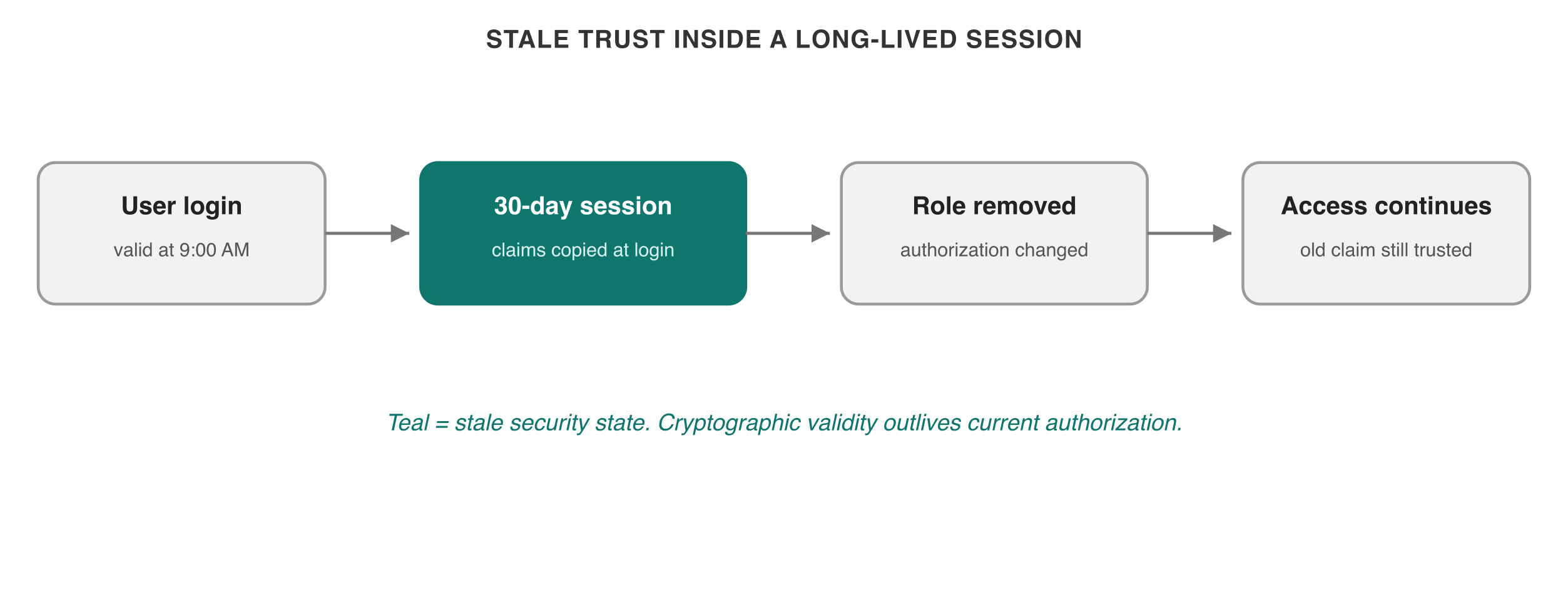
This is the first design decision that matters: what must be checked on every request, and what can safely remain fixed until expiry. User identity might be stable for the session. Tenant membership, account status, risk level, and sensitive permissions often are not.
Keep the browser credential small and meaningless
The browser should hold an opaque, high-entropy session identifier in a cookie with Secure, HttpOnly, and an appropriate SameSite policy. It should not hold the full authorization model in a value that every service learns to trust independently.
RFC 6265 defines cookie behavior, but cookie flags are only transport controls. They help protect the identifier. They do not solve rotation, revocation, or authorization freshness.
A server-side session record can stay compact:
type SessionRecord = {
  id: string;
  subjectId: string;
  tenantId: string;
  createdAt: number;
  lastSeenAt: number;
  idleExpiresAt: number;
  absoluteExpiresAt: number;
  authLevel: "password" | "mfa";
  version: number;
  revokedAt?: number;
};
Notice what is not there: a copied list of every permission the user had at login. Keep stable session facts in the record, then resolve authorization that can change from the current policy or membership source. Otherwise the session store becomes a warehouse of stale entitlements.
Rotation closes a window that expiry leaves open
Session expiry answers how long a credential may live. Rotation answers whether the same credential should survive a security boundary such as login, MFA completion, password reset, tenant switch, or privilege elevation.
Without rotation, an identifier captured before login can become an authenticated session after login. That is session fixation. Without rotation after privilege elevation, the same long-lived identifier moves from ordinary access to sensitive access with no new boundary around it.
The safe pattern is to create a new identifier and invalidate the old one atomically:
async function rotateSession(oldId: string, update: Partial<SessionRecord>) {
  return sessionStore.transaction(async (tx) => {
    const current = await tx.getForUpdate(oldId);

    if (!current || current.revokedAt) {
      throw new Error("session is no longer active");
    }

    const next = {
      ...current,
      ...update,
      id: crypto.randomUUID(),
      version: current.version + 1,
      lastSeenAt: Date.now(),
    };

    await tx.revoke(oldId, Date.now());
    await tx.insert(next);
    return next;
  });
}
Atomicity matters. If both identifiers remain valid during a race, rotation has created a second session rather than replacing the first one.
Revocation must reach every service
Central session storage gives you a revocation point, but only if every path actually checks it. A normal HTTP request may load the session on every call while a WebSocket authenticates once and remains connected for hours. A queued job may have copied the subject and tenant into its payload. An internal service may cache a successful session check for longer than the revocation target.
This is why a useful session design begins with a revocation objective. If disabling an account must stop sensitive actions within five minutes, every cache, connection, and worker must either revalidate inside five minutes or receive a reliable revocation event. Writing revokedAt into Redis does nothing for a process that never looks again.
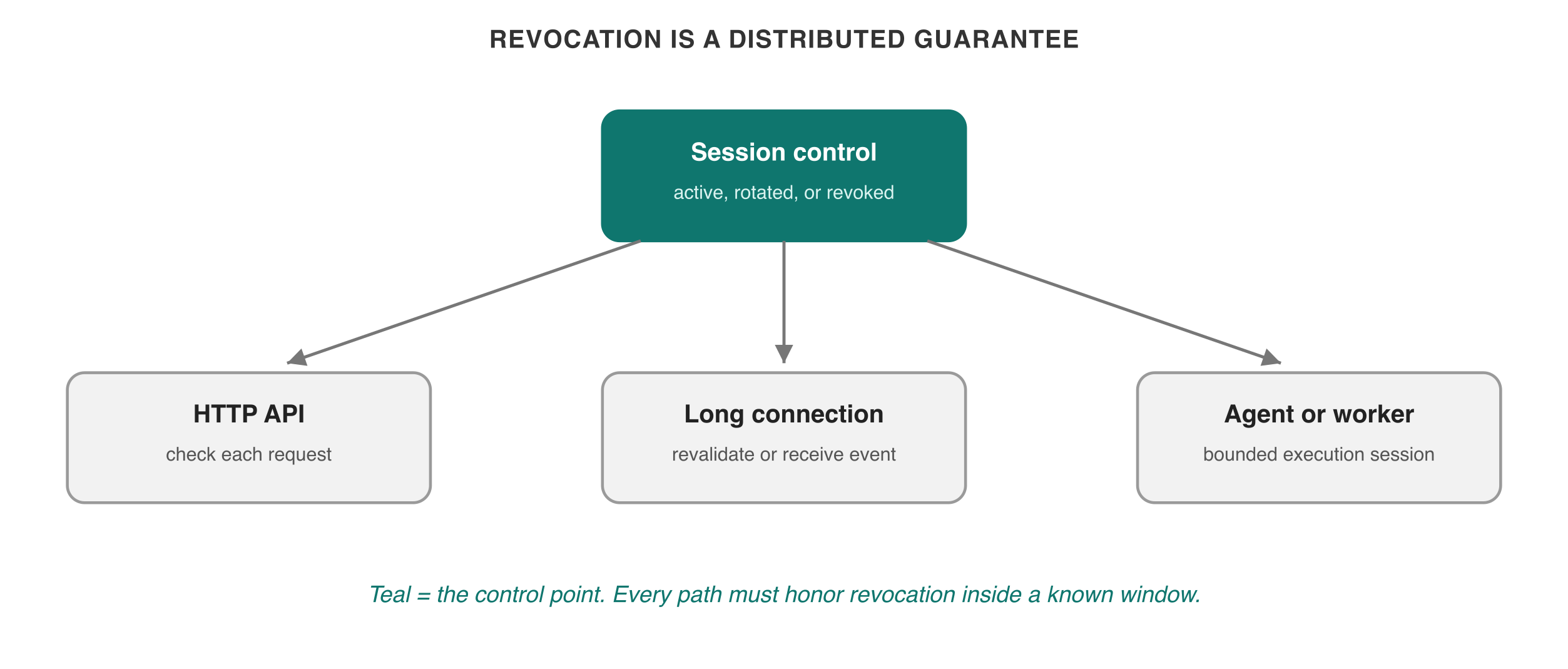
For high-risk actions, check current session state immediately and require step-up authentication when the authentication level is not sufficient. For lower-risk reads, a short cache may be reasonable. The policy should be explicit. Accidental cache duration is not a security policy.
NIST SP 800-63B is useful here because it separates overall session lifetime from inactivity timeout and reauthentication requirements. Those controls should not collapse into one TTL field. An active session can still hit its absolute maximum, and a session inside its maximum can still require fresh authentication before a sensitive action.
AI agents create sessions inside sessions
An agent task is often treated as a background continuation of the user's browser session. The user starts a task, the agent receives some credentials, and it keeps running. But the browser session may end while the task is still making decisions. If the agent simply copied the original bearer token, logout becomes mostly cosmetic.
The agent needs its own bounded execution session. It should identify the workload, preserve who delegated the task, target one tenant, and carry only the scopes needed for that task. Its lifetime should reflect the work, not the user's browser-cookie lifetime. If it delegates to another agent or tool, the downstream credential should become narrower, not inherit everything.
OAuth 2.0 Token Exchange from RFC 8693 gives a useful pattern for creating that downstream credential. The browser session establishes the human context, but the agent receives a separate short-lived token with its own audience and traceable delegation. Revoking the task can then stop the agent without destroying every user session, and revoking the user can still cascade to active tasks when policy requires it.
This distinction also improves audit logs. "User 123 made API call" is incomplete when an autonomous workload performed the call twenty minutes after the user clicked a button. Record the session, agent identity, delegated subject, tenant, and task identifier. Otherwise all autonomous work becomes indistinguishable from direct human action.
Availability cannot quietly disable security
A centralized session store becomes critical infrastructure, so teams are tempted to fail open when it is unavailable. That turns an operational incident into an authorization bypass. If a service cannot determine whether a sensitive session is active, it should not assume active.
You can reduce the availability risk with replicas, regional stores, carefully bounded local caches, and signed short-lived proofs. But every optimization needs a maximum stale-trust window. A five-minute cache is a decision that revoked access may continue for five minutes. Sometimes that is acceptable. Pretending it is only a performance setting is not.
Monitor identity outcomes, not just cache latency. Track rejected expired sessions, revoked-session reuse, rotation failures, impossible tenant switches, and how long revocation takes to reach long-lived connections. A session system can have perfect uptime while authorization freshness is completely broken.
The takeaway
Session management at scale is the work of keeping trust current while it spreads. Store as little as possible in the browser, rotate identifiers when trust changes, separate idle and absolute lifetime, and make revocation reach every execution path inside a known window.
For AI agents, do not stretch a human browser session until it covers autonomous work. Create a smaller, traceable execution session with its own identity and expiry. The moment a session crosses a service boundary, it becomes identity architecture, full stop.
Akash Devdhar is a Senior Software Engineer specializing in enterprise identity, authentication, authorization, and AI infrastructure. He writes about building secure AI systems using OAuth, OIDC, RBAC, and modern identity architectures.